
Three teachers I had the privilege of studying under stand out as having made the greatest impact on my thinking about the concept of truth.
Mr. Kruzan, my humanities teacher in high school, instilled in me a sense of wonder and curiosity and a passion for art, history, and an appreciation for people and cultures different than mine. His influence led to my love for both philosophy and music. He made learning fun. Education to him wasn’t just stats and data: it was an adventure, a journey of discovery. He showed me just how big the world is and how tiny I am in comparison. He dared his students to dream and explore.
Dr. Stark, the philosophy professor at the community college I attended, inspired me to think critically, push aside my prejudices, ask pertinent questions, subject any and all truth claims to the test of rational scrutiny and criticism, and seek after the truth without compromise. He dared his students to question and apply logic and reason.
Dr. Burlington, who taught world religions and humanities classes at the Christian college I attended, encouraged a truth-seeking mentality comprised of compassion towards those who adhere to different beliefs, as well as a desire to understand both what other people believe and why they hold such beliefs, in the hope that perhaps we can learn from one another, understanding that none of us has found all the answers to the big questions about “life, the universe, and everything.” He dared his students to listen empathically and practice grace.
Because of their teachings, I have devoted my life to a pilgrimage towards truth.
A pilgrim is one who journeys, oftentimes long distances, to either a new or sacred destination. In the process of traveling, one may discover new truths about the world and about oneself, thus making the pilgrimage itself – the experiences of the journey – a life teacher. I see myself as a pilgrim, on a journey towards something that is both new and sacred. I am on a journey towards truth, a pilgrimage for understanding. I’ve been on this journey for a long time, since before I had any white in my hair.
Perhaps I will never know the truth completely, thus never actually reaching my destination, or maybe even knowing which direction I need to go to reach it; nevertheless, the journey is as important as the destination. This mindset is borrowed from a concept in Buddhism…
The path is the goal.
I study and teach martial arts, so a relevant question for me is, “What is the goal of a martial artist?” That of course depends on the context. Maybe your goal is to compete in a sport, or get into better shape, or feel confident in your self-defense skills, or learn all the history behind your art, or become a great teacher. Maybe you want to use your art as a form of self-expression or to get into movies as a fight choreographer.
The goal then would be to become the best we can be at whatever aspect of the martial arts we pursue, like we’re striving for perfection. The problem is, no matter how much we practice, we still make mistakes. Perfection is impossible because we are imperfect. Experience tells me that I will never reach my goal. Contrary to the colloquialism, practice does not make perfect. That’s why I created this motto for my students…
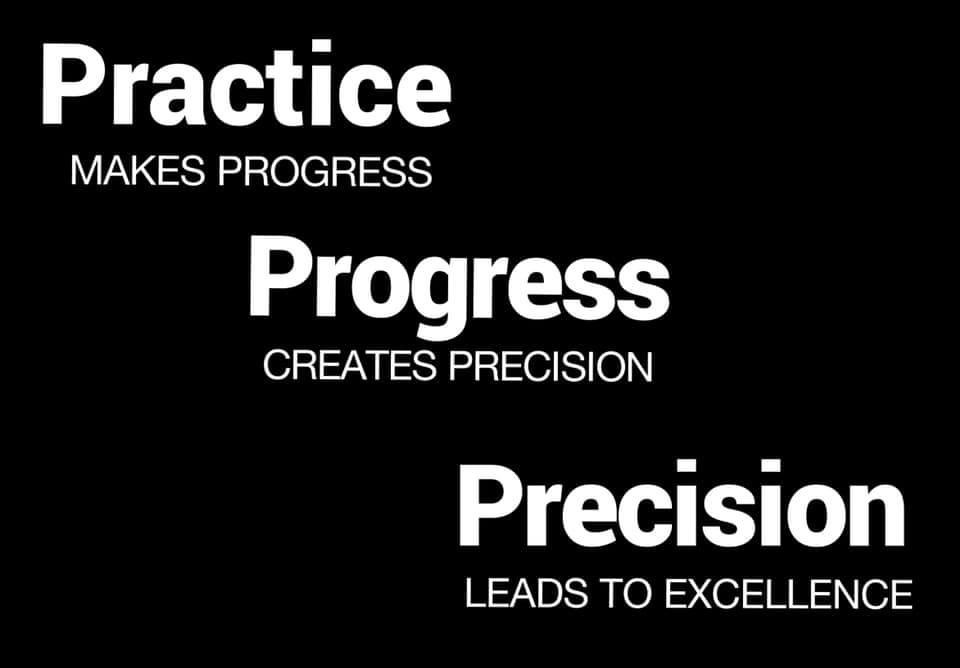
If we can’t be perfect, should we then stop practicing? Of course not. Even Michael Jordan missed several shots in his career. Striving for perfection even though I know I’ll never reach it can still push me to reach beyond what I think are my limits. This reminds me of the quote attributed to Norman Vincent Peale:
“Shoot for the moon. Even if you miss, you’ll land among the stars.”
Honestly, I’ve never read any of Peale’s work, and my brain can’t get past the fact that the stars are much farther away than the moon so the quote would make more sense if it were reversed:
“Shoot for the stars. Even if you miss, you’ll land on the moon.”
That doesn’t have the same poetic punch to it, though. Regardless, if we reach for something that’s beyond our grasp, we may stretch ourselves farther than we would have if we only reached for what we told ourselves we could attain. The process of reaching makes us attain more than we thought we could. Meanwhile, the reminder that we are imperfect will hopefully keep us grounded and humble along the way. The path, again, is itself the goal.
Likewise, even if I never reach my goal of complete knowledge and understanding – even if I never discover the absolute truth – the journey itself may benefit me in that I may be better equipped at least to recognize falsity, and perhaps come just a little closer to understanding that which is true. In the process I learn and utilize reasoning skills which will serve me well in the everyday decisions of life. Only by embarking on this pilgrimage may I develop and implement such indispensable tools as critical thinking, objective reasoning, active listening, respect for our world, and compassion for others.
There are a lot of con artists in the world. We need to stay sharp.
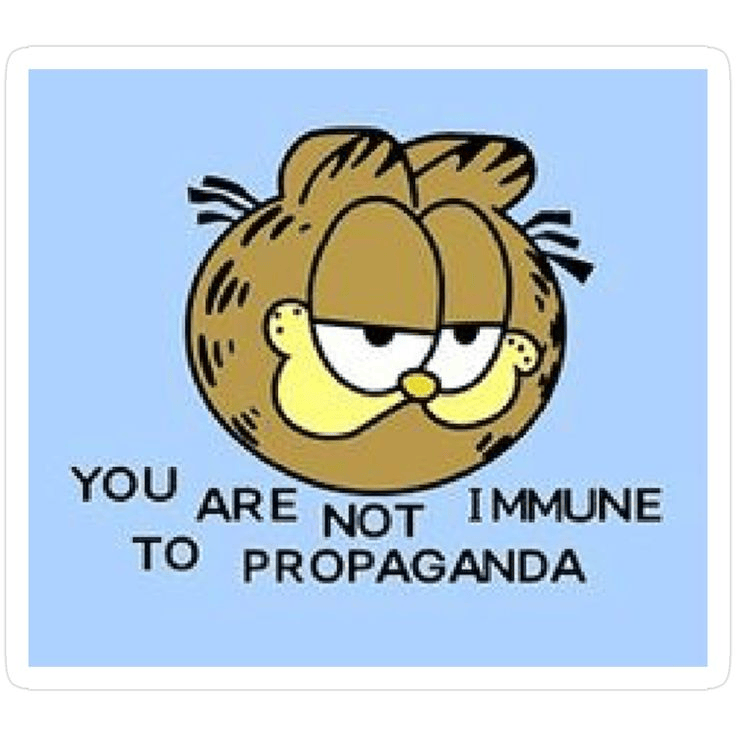
The pilgrimage itself also benefits us in that it’s a journey of discovery and wonder. Learning new things is fun. People go on hikes and road trips and get lost intentionally just for the experience of seeing what they might find along the way.
This brings me back to the topic of artificial intelligence. The technology as it has been presented for the population to use is robbing people of the journey itself. Even if A.I. gains the ability to create pictures and movies and written works better than anything humans could create (and that’s a subjective evaluation to be sure), the output – the end goal – isn’t always the most important priority when it comes to either art or education. When our technology robs us of the journey itself, it robs us of growth, knowledge, and experience, like taking a robot to the gym with you and have them do all the exercises while you watch. Our minds, our attention spans, our memories, and our ability to discern and think critically atrophy just as easily as our muscles do.
The people with power want us to be weak. They weaker and less equipped we are, the more easily the predator class can manipulate and exploit us for their own gain. Don’t give them that kind of control over you.
“Knowledge itself is power.” – Francis Bacon
I want to foster wonder in both the mysteries of the world and the potential for discovery. I want to encourage others to understand and appreciate the journey itself and take part in what philosopher Norman Melchert calls “the Great Conversation” that has taken place throughout the course of human history and still continues today. Let’s go on a pilgrimage and see what we may find.
“Not all who wander are lost.” – J.R.R. Tolkien
☮️❤️👻🦞💀


