This is a follow-up to my last post, Four Columns, or The Sermon That Made Me An Agnostic, where I refer to myself as an “agnostic.” This label, like “atheist” or “Christian,” comes with certain social connotations. And while labels can help people gather with other like-minded people, a label doesn’t give the whole picture of what an individual believes.
Like I said in Four Columns, I went from Christian minister to agnostic to atheist back to agnostic. And by that I mean those were the labels I used for myself. I found myself part of the secularist / humanist / freethinker / atheist community during the height of “New Atheism” in the early 2000s and the “Four Horsemen” who stood as the rockstars of the movement: Richard Dawkins, Christopher Hitchens, Sam Harris, and Daniel Dennett.
Honestly, it was a fun time to be an atheist. This was before Hitchens died and Dawkins was shown to be an out of touch boomer we’re all better off ignoring.
I made this chart way back then (on MS Paint of all things). I wasn’t the first to make something like this. This is just the one I made.
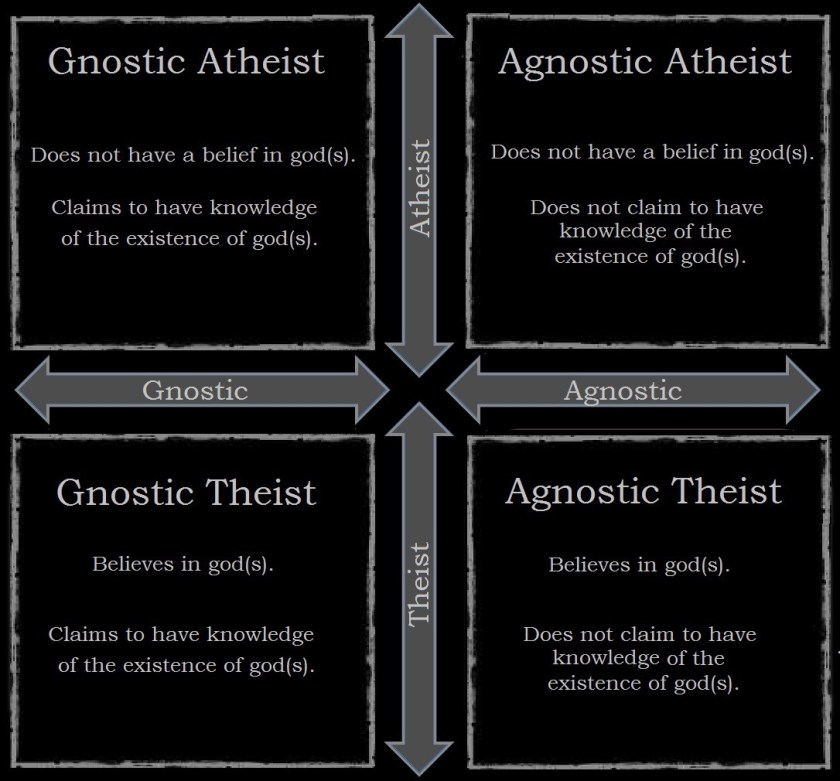
“Agnostic” by definition means, “does not claim to know anything about the existence of a god or gods.” When I say I was (or am) an “agnostic,” that says nothing about my actual beliefs. The label only speaks to what I claim to know or not know.
“Atheist” just means someone does not have a belief in a god or gods. There’s what some call “strong atheism” where one makes the positive assertion that there’s no god(s), as opposed to “weak” or “soft atheism” where one does not believe in god(s) but does not explicitly assert that there definitely is no god.
In one sense, most people are atheistic in terms of which god(s) they do not believe in. An evangelical Christian, for example, is atheistic towards Ahura Mazda, the Lord of Wisdom and supreme creator god in Zoroastrianism, just as they are atheistic towards Zeus and Athena in Greek mythology.
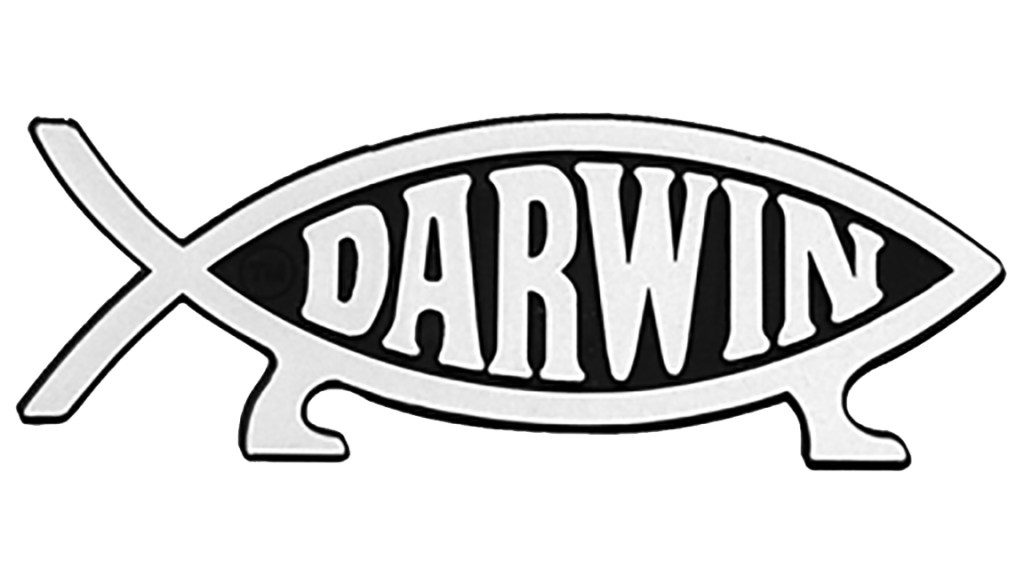
But that’s not how we use the label colloquially. If someone says they’re an “atheist,” that usually implies that they aren’t religious and are advocates of science and reason in the “I have a Darwin Fish Bumper Sticker on my Prius” sense.
This doesn’t apply to everyone who uses the “atheist” label of course, but an entire subculture arose around this understanding of what an “atheist” is, and for a time, I considered myself part of it.
I don’t use either “atheist” or “agnostic” as a public label for myself anymore. I’ve drifted away from that subculture over the years, though I still adhere to many of the values of the movement. I don’t call myself an atheist because, on any given day, I don’t whether I am. And while I call myself “agnostic,” I don’t use it as a social label.
This blog post is the first time in a long time that I’ve discussed matters related to a community I haven’t been an active participant in for well over a decade. My online activity these days is squarely in the political realm rather than in the world of “Theism vs Atheism.”
And the most significant reason for this shift is that my spiritual journey is deeply personal. This brings me to a video I saw recently by culture critic Monte Mader who expressed this sentiment better than I could. A clip is below with a link to her full video…
Monte Mader: This is a place of questioning
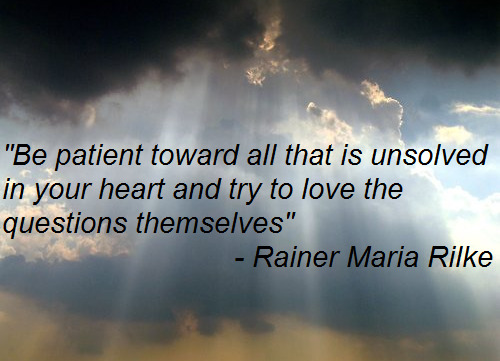
“…There’s a reason I don’t talk about my faith or spiritual practice online because my greatest complaint against organized religion is that it tells us what to think and not how to think.
There is something deeply sacred in wrestling with your own faith, your own worldview, asking questions, taking a topic and breaking it apart and seeing if the truth holds up to scrutiny because the truth always will.”
– Monte Mader
Philippians 2:12 guides us to “work out your own salvation with fear and trembling.” This to me implies humility, curiosity, wonder, and a respect for the magnitude of the subject matter. It comes with an understanding that humans do not have perfect knowledge, and no human can represent the divine faultlessly or completely. Any god(s) our imperfect brains could comprehend completely would be a tiny god.
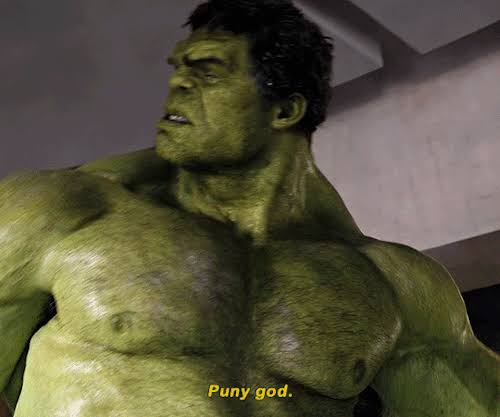
If God is anything like how the Western religions understand him, then he is far beyond our ability to understand or apprehend completely.
When we see how empire utilizes religion to push their agenda, and particularly how our current government weaponizes a specific brand of Christianity in the United States, we don’t see humility. We don’t see many of these believers “working out their salvation with fear and trembling.” We see pride. We see arrogance. We see hatred, judgment, exclusionism, bigotry, and condemnation.
What we need instead are attributes like those listed in Galatians 5:22-23. We need to practice more love, joy, peace, kindness, and self-control, and work to build a society that allows individuals the freedom to pursue their own spiritual path, even if one’s own journey isn’t considered spiritual at all, without the threat of discrimination, oppression, and violence.
If a believer’s worldview doesn’t allow for this, then perhaps their concept of God is too small. Or their ego is way too big.