
or,
The Sermon That Made Me An Agnostic
“We sit outside and argue all night long
Primitive Radio Gods,
About a God we’ve never seen but never fails to side with me.”
Standing Outside A Broken Phone Booth With Money In My Hand
I spent my 20s as a Christian minister and online Christian apologist and blogger. In fact, the Dead-Logic blog started as a Christian apologetics blog over on Blogger. I’ve been blogging on and off for many years. The bulk of this article is from a blog entry I wrote in 2011. I’ve updated it to share here.
I delivered a sermon back in the year 2000 in which I described four categories of understanding, or knowledge columns as I called them back then. The purpose of these columns, as I’ll explain in more detail later, is to address the question of how well we understand God, his will, doctrine, and how we understand ourselves in light of all this. I came across some old notes from that sermon and that got me thinking about the intellectual and spiritual journey I’ve been on since I preached this sermon all those years ago, back when the Internet was young and we looked forward to what the new millennium would bring us.
(We had no idea it would be this bad.)
I began my sermon by explaining the dichotomy between the noumenal and the phenomenal in Immanuel Kant’s epistemology. Sounds like I was a boring preacher, I know, but it actually wasn’t as bad as you might think. I told jokes and stuff.
Noumena refers to the “thing in itself” (Ding an sich), or reality as it is independent of our experience of it. Phenomena refers to the appearances which constitute our experiences. Put roughly, the noumenal is reality as it actually is, whereas the phenomenal is reality as we perceive it.
Philosophers and theologians have wrestled fiercely with the implications of Kant’s epistemic dichotomy. I mentioned it to make the point that things aren’t always as they appear. We are fooled easily. Our senses deceive us. Our brains are not 100% reliable. What’s more, whether we can ever even know the “thing in itself” at all is a question that hangs over philosophers like the Sword of Damocles (Now I have that song from Rocky Horror in my head, IYKYK). If our senses are all we have to acquire knowledge, how can we ever get beyond the phenomenal?
Column One: What I Think
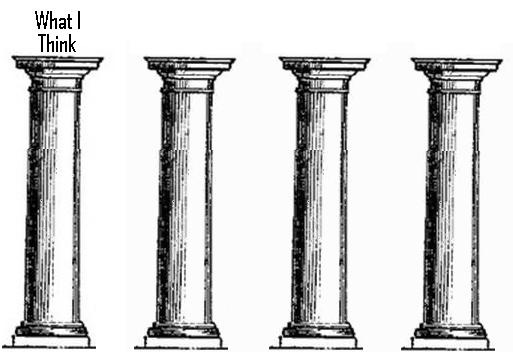
The first column represents what a person actually believes (whatever that may be), not necessarily what they know or can prove. This column represents one’s worldview.
Column Four: What God Thinks
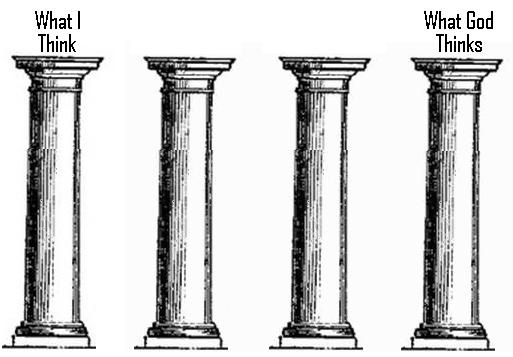
In my sermon, I skipped to Column Four, explaining that, while you and I may think one way about an issue, God might have an entirely different thought on the matter. God-followers should be concerned with learning what’s found in Column Four. That leads us to Column Three:
Column Three: What I Think God Thinks
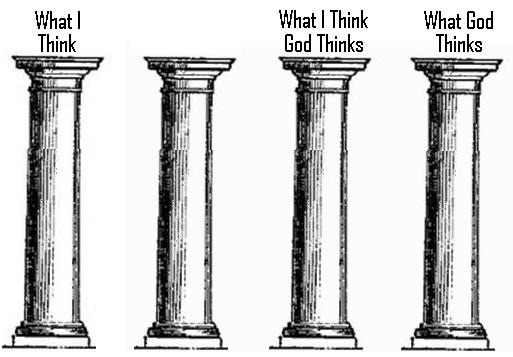
Here’s where things get tricky. Once I established that God has his own set of thoughts, and those thoughts might not agree with ours, I backed up a step to Column Three, turning the focus back to our perceptions and interpretations. What do we think God thinks? People of every flavor of theism tend to presume (usually without thinking about it consciously) that their values, morals, and preferred virtues are God’s virtues, and vice versa. I noted to my congregation how interesting it is to me that so many people found a god to follow who quite conveniently agrees with everything they want to believe.
And when the average believer runs into another believer whose Column One doesn’t match up with their Column One, they run to the Bible or some other noteworthy authority to find “proof” to demonstrate to their misguided friend that Column Four – God’s column – agrees with their Column One.
Instead of letting the data guide them towards a conclusion, they start with their conclusion and work backwards to find evidence to support their beliefs.
Column Three has turned out to be quite a sticking point for me over the years. There’s enough disagreement and division in Christianity alone to warrant a healthy dose of skepticism without having to consider all the other religions in human history. If one of the prime directives of being a disciple of God is, as I preached in my sermon so long ago, to get one’s Column One to match up with Column Four as closely as possible, why is there so much disparity in Column Three? If God has something eternally important to communicate to the world, why is every message he has allegedly ever sent either ridiculously ambiguous, nonspecific and/or unverifiable?
I thought a lot about Immanuel Kant. Rejecting the traditional arguments for god’s existence, Kant denied that we could ever really know that there is a God. A believer in God himself, Kant wanted to distinguish the noumenal from the phenomenal in order to place limits on human reason. He writes in the Preface to the second edition of the Critique of Pure Reason (1787), “I had to deny knowledge in order to make room for faith.”
Kant, in his attempts to rescue faith, laid the foundation for a more modern expression of agnosticism. Kant’s rejection of a Thomistic attitude toward faith and reason anticipates the thoughts of the man who coined the term “agnostic,” Thomas Henry Huxley:
I neither affirm nor deny the immortality of man. I see no reason for believing it, but, on the other hand, I have no means of disproving it. I have no a priori objections to the doctrine. No man who has to deal daily and hourly with nature can trouble himself about a priori difficulties. Give me such evidence as would justify me in believing in anything else, and I will believe that. Why should I not? It is not half so wonderful as the conservation of force or the indestructibility of matter…
It is no use to talk to me of analogies and probabilities. I know what I mean when I say I believe in the law of the inverse squares, and I will not rest my life and my hopes upon weaker convictions…
That my personality is the surest thing I know may be true. But the attempt to conceive what it is leads me into mere verbal subtleties. I have champed up all that chaff about the ego and the non-ego, noumena and phenomena, and all the rest of it, too often not to know that in attempting even to think of these questions, the human intellect flounders at once out of its depth.
– Thomas Henry Huxley,
in a letter of September 23, 1860, to Charles Kingsley
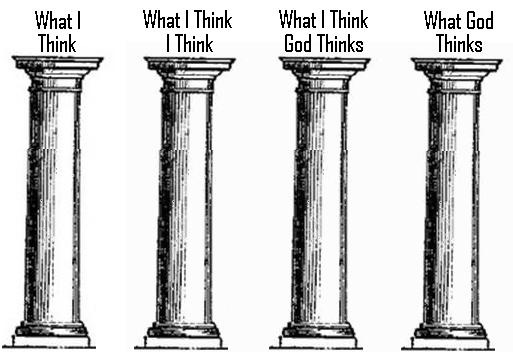
Column Two: What I Think I Think
Fans of the 2002 TV show Firefly will remember Shepherd Book quoting a fictional warrior-poet and psychotic dictator named Shan Yu, who said: “Live with a man forty years. Share his house, his meals… speak on every subject… then tie him up and hold him over the volcano’s edge. And on that day, you will finally meet the man.” A person may claim many things about what they value or believe, but when one is put to the test, will their deeds match their claims?
We back up to Column Two, thus completing our Four Columns. This column deals with one’s self-perception. It is, in my estimation, an even trickier column than Column Three, for many people might have a difficult time distinguishing this column from Column One. But there is a big difference. Column One contains what a person actually thinks and believes. Column Two contains what a person has convinced oneself that they really believe.
Humans are really good at lying to themselves.
I gave an example in my “Four Columns” sermon of a religious believer who tells himself that he wants to understand and obey the will of God; that is, he wants his Column One to square up with God’s Column Four. He tells himself this – convinces himself that this is what he wants – but then he spends every moment of his week aside from Sunday morning doing things that are contrary to God’s mandates. In a moment of true contrition, the man realizes that what he proclaimed to the world and to himself has been a lie. What he really valued (his Column One) wasn’t what God valued (Column Four). While the man’s Column Two seemed to line up with Column Four (or at least Column Three), that wasn’t good enough.
The Grindr app crashes whenever there’s a Republican convention. You know, the party that’s opposed to LGBT+ rights. That tells me there are a lot of closeted conservatives who think they believe one way (or want to believe a certain way), but their actions tell a much different story (or they’re just using Christianity to grift, but that’s a topic for another time).
Humans are really good at cognitive dissonance.
Near the end of my Christian life, Column Two proved to be the most damning of the columns for me. My entire spiritual life – and especially my work as a Christian apologist – became one attempt after another to convince myself that what I wanted to believe is true. Every argument and piece of evidence I supplied as an online apologist helped to prolong my cognitive dissonance and strengthen the illusion that I in fact possessed the gnosis so many other Christians claim to have.
Turns out I was that religious believer I talked about in my sermon. In a moment of deep contrition, I realized that what I thought I believed – what I kept trying to convince myself that I believed – wasn’t what I really believed deep down. I saw myself trapped by wishful thinking, denial and resistance to change. I wanted my worldview to be correct. I wanted my Christian faith to be justified. I didn’t want to lose my community. I didn’t want to lose my friends. I didn’t want to lose that sense of purpose being in ministry gave me. I didn’t want to give it all up. I feared the unknown; rather, I feared not knowing.
And that’s the part that hurts. People who called me their friend – people who called me brother – abandoned me when I gave up the “Christian” label. They accused me of being weak, or “copping out,” or wanting to rebel. One person said I have a demon inside me. But the truth is, I DIDN’T WANT TO LEAVE. I held on for as long as I did because I knew what I’d lose if I left.

In time, my emotional side caught up to my rational side, and I knew I had no other choice but to own my lack of knowledge; like Socrates, I became aware of my ignorance, seeing wisdom in understanding that I was not wise. Concordantly (I use words like concordantly when I want to sound smart), I shed myself of this faith that I could not justify and had no reason to believe. After examining my own knowledge columns, I reached the state of mind in which I could embrace agnosticism openly and graciously.
When I reached intellectual maturity and began to ask myself whether I was an atheist, a theist, or a pantheist; a materialist or an idealist; Christian or a freethinker; I found that the more I learned and reflected, the less ready was the answer; until, at last, I came to the conclusion that I had neither art nor part with any of these denominations, except the last. The one thing in which most of these good people were agreed was the one thing in which I differed from them. They were quite sure they had attained a certain “gnosis,”–had, more or less successfully, solved the problem of existence; while I was quite sure I had not, and had a pretty strong conviction that the problem was insoluble.
So I took thought, and invented what I conceived to be the appropriate title of “agnostic.” It came into my head as suggestively antithetic to the “gnostic” of Church history, who professed to know so much about the very things of which I was ignorant. To my great satisfaction the term took.
– Thomas Huxley
Collected Essays, pp. 237–239
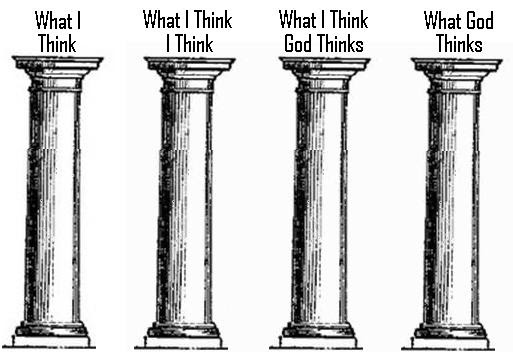
These four columns in my sermon were meant to encourage believers to seek the will of God. Instead they became signposts pointing me to the truth that Column Two (What I think I think) and Column Three (What I think God thinks) exist only because God hasn’t clarified to us what’s in Column Four. Kant would tell me we can’t know what’s in Column Four, and that’s why we need faith. But even if we can never really know anything past the phenomenal, God could certainly communicate with us more clearly if he wanted to, couldn’t he? If we can’t know what’s there, maybe the truth is much simpler than that: maybe there is no Column Four. Or maybe God has shown us everything he wanted to and is now watching to see what we do with what little we have.
Still, the words of Matthew 7:7 continue to haunt me as they always do…
Ask and it will be given to you;
Seek and you will find;
Knock and the door will be opened to you.
I went from Christian minister to agnostic to angry atheist back to agnostic to now, still an agnostic, but always seeking truth. If God is the truth, then I am seeking God, whether I realize it or not. And maybe, if God exists, matching up our Column One with God’s Column Four is more about following the most basic of his commandments, which also happen to be what Jesus called the most important of God’s commandments, and less about fighting and dividing over whose theology is more accurate. None of us have perfect knowledge. We just look down on each other as though we do.
We don’t acknowledge our shared imperfections with each other nearly as much as we should.
Is that heresy? I guess, but is eternal salvation really about knowing the right things? Would a loving God not save me just because I couldn’t figure it out or I just got the answer to the question wrong? Am I saved by the power of the cross or by the power of my ability to know stuff?
The God of the Bible tells us to ask, to seek, and to knock. We ask because we don’t know. We seek because we don’t have. And we knock because, in the end, we can’t open that door ourselves. Only God can. And if he wants to, he will. That’s my Column One. Sounds like a mustard seed’s worth of faith to me, anyway. But what do I know?
All I know is that I know nothing. If God is out there, he knows I know nothing. And I know that God knows that I know he knows that I know nothing.
You know?


One thought on “Four Columns”