
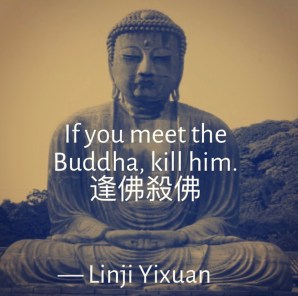
“If you meet the Buddha, kill him.”
The master explains to the monk that this is nothing special at all, and can even hinder his real progress. The master then instructs: “If you see the Buddha, kill him.”
While various interpretations of this Zen kōan have been offered over the years, I’ve found value in understanding “the Buddha” we encounter to represent our desire for enlightenment rather than enlightenment itself. Humans long to be right, and we generally hate being wrong. That longing can lead us to convince ourselves we know more than we actually do. It’s a typical human habit to assume or just make something up to fill in the gaps in our knowledge.
The human brain is built to search for patterns, and is constantly working to solve problems even when we’re thinking about something else. And when our pattern-seeking brain comes across ambiguous stimuli – when it can’t quite figure out what we’re looking at – it interprets what we see as patterns we’re familiar with. That’s why we see things in clouds. It’s a phenomenon known as pareidolia.
Our brains are more or less wired to make up stuff when it can’t figure out what we’re seeing. I take that as a reminder that we should work hard to not fall into assumptions about what we think we know, and what we think we know should be supported by evidence, reason, data, and experience.
The illusion of wisdom is far more dangerous than ignorance.
So we must kill the Buddha because the Buddha we meet is not the true Buddha, but a manifestation of our desire to know. If this Buddha we meet along the way is not killed he will only get in the way.
Maybe the Buddha we meet comes in the form of a mentor or teacher we admire. As much as we look to these people for guidance and wisdom and as often as they have provided good instruction and guidance, they too are still on a journey. “Killing” such a Buddha means we don’t turn these wise people into idols we follow unquestioningly. All of us are, after all, only human.
Perhaps the Buddha we come across on our journey is the set of beliefs we prefer, or the prejudices we haven’t yet learned to overcome, or the lies we tell ourselves to assuage our insecurities and fears.
Anything that can hinder true understanding – our desires, our biases, our egos – are Buddhas we need to kill.
Linji Yixuan said, “‘Buddha’ means pureness of the mind whose radiance pervades the entire dharma realm.” Linji is talking about Buddha Nature, which in Mahayana Buddhism is the fundamental nature of all beings. In Zen, “When you meet the Buddha, kill him” refers to “killing” a Buddha you see as separate from yourself because such a Buddha is an illusion.
I’m reminded of the 1978 film Circle of Iron starring David Carradine. Cord, the main character, is seeking a special book of enlightenment. When he overcomes all the trials and finally finds the book, he opens it to find that the pages are mirrors. True enlightenment, Cord discovers, is found only in oneself.
What is “enlightenment”? I have a few suspicions, but the search for truth continues. I’m inclined to believe, as I’ve said elsewhere, that “the path is the goal.” The search for truth is a lifestyle. It’s as much about the journey – the pilgrimage, if you will – than the destination. Maybe even more so.
Just keep an eye out for any Buddhas that need slain along the way.

 Dead-Logic
Nice reflections. It’s never been one of my favourites, but then I’m not sure how find l fond I am of Koans really; they seem cool, but I think they seem a little merciless as a practice
LikeLiked by 1 person