
“Wonder is the feeling of a philosopher, and philosophy begins in wonder.”
— Socrates [Theaetetus, 155d]
A friend of mine who knows I have a degree in philosophy once asked me: “Can you tell me, in one sentence, what philosophy is?” I answered, “Philosophy is the attempt to ask questions about the nature of everything in the pursuit of truth.” I then realized, regardless of how accurate my answer is, it won’t help someone not familiar with philosophy understand what the discipline is. I also considered the fact that several other definitions of “philosophy” can be given that are as accurate, if not more so, than my own.
The study of philosophy often doesn’t begin with a solid definition of the subject; rather, it seems simpler to define philosophy by doing philosophy. But having a solid definition is nonetheless important. With that in mind, I strive to answer his question (though in more than just one sentence): What is philosophy?
The word philosophy – φιλοσοφία – is derived from the Greek words philos (love) and sophia (wisdom), and is translated literally as “the love of wisdom.” Philosophy begins with wondering, questioning, and reflecting about our fundamental assumptions. Philosophy is about asking questions – the big questions of life, the universe, and everything – and looking for the answers. The purpose of philosophy is for the rational being to examine the various aspects of life, the various fields of study and the various theories and claims, logically, clearly and comprehensively, in order to find the truth. Philosophy, in one way or another, touches upon virtually every aspect of human life. Philosophy focuses on art, science, medicine, religion, politics, the human experience, morality, death, and much more. Philosophers engage in careful thought and reflection about the nature of the world, the extent of knowledge, and the evaluation of human conduct.

Those who study philosophy are perpetually engaged in asking, answering, and arguing for their answers to life’s most basic questions. Philosophers ask and attempt to answer the questions which most people do not, cannot, or do not have time to answer. If philosophy is the art of asking questions, then questions are the philosopher’s tools. “Is there a god?” “Why am I here?” “What is humanity?” “What is the good in life?” Questions, and the curiosity to find answers, are what make the philosopher search for truth and wisdom. The pursuit of truth is the philosopher’s prime directive. The philosopher attempts to find truth through logic and reason. So, the philosopher’s passion and emotion must not replace logic and reason to find truth, they must be the driving force behind why the philosopher uses logic and reason to find truth.
Philosophy is traditionally divided into four main branches of study. The first branch is Metaphysics, which is the study of ultimate reality. The word “metaphysics” literally means, “after the things of nature.” Physics is the study of the physical reality, whereas metaphysics is the study of reality “beyond the physical” (if, indeed, there is such a reality – metaphysics addresses such questions). The next branch of study is Epistemology, which is the study of knowledge – what knowledge is and what it is all about. Questions concerning what can be known (if anything), how much can be known, and how do we know what we know is dealt with in epistemology. The next branch of philosophy is Ethics, which is the study of morals and ethical living. Questions and theories arise in this field concerning why one should be good, what is the true ethical standard (if any), and how and why should one live right. The fourth main branch of philosophy is Logic. Logic is the field of study that deals with how a rational being reasons and draws conclusions. The philosopher uses logic to determine if arguments are valid and sound, and if ideas and premises are rational and true.
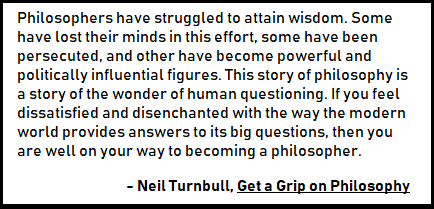
Other branches of philosophy include Aesthetics, the study of beauty; Politics, the study of legal rights and government; and History of Philosophy, which involves seeking to understand the way in which the great philosophers of history have answered such questions in the past. A significant part of philosophy is its history: a history of answers and arguments about the “big questions.” Many philosophical studies are categorized by subject, such as “philosophy of science,” “philosophy of mind,” “philosophy of religion,” “philosophy of language,” “philosophy of feminism,” and so on.
The philosopher engages in two tasks. The first task is the elimination of nonsense. The second task for the philosopher is the discovering of truth. The first task involves getting rid of anything contradictory, implausible, or nonsensical. In other words, this involves removing anything that is false or irrational from the conversation. This is the negative task of philosophy. The second task involves reasoning to conclusions that reveal the truth. This is discovering, or uncovering, what is real. This is the positive task of philosophy. Philosophers also question to what extent we can accomplish either task, yet both tasks are vital to the philosopher.
In the end, the aim of philosophy is to understand ourselves, our world, our values, life, the universe, and everything. Humans are curious creatures. We want to understand such things and, whether consciously or otherwise, we develop worldviews in an attempt to understand. Sometimes we rush to our conclusions too quickly. As the “Karate Nerd” Jesse Enkamp said, “the problem with humans is that we don’t seek knowledge, but certainty.”
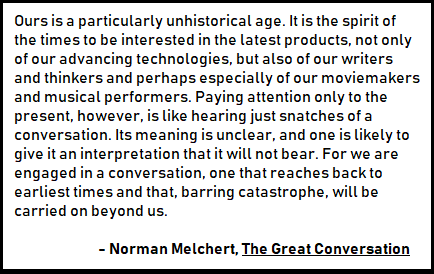
Everyone views the world in a certain way. This means everyone does a little bit of philosophy, even when one has never received formal training. The relevant question is: will we seek to do philosophy well?

 Dead-Logic
Well analyzed
LikeLike