
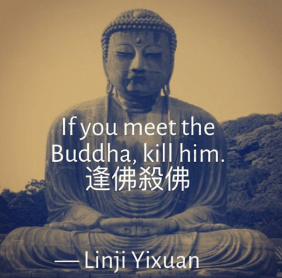
“If you meet the Buddha, kill him.”
A monk deep in meditation experiences what he thinks is enlightenment – the awakening, the Buddha-mind – and reports this to his master.
The master explains to the monk that this is nothing special at all, and can even hinder his real progress. The master then instructs: “If you see the Buddha, kill him.”
While various interpretations of this Zen kōan have been offered over the years, I’ve found value in understanding “the Buddha” we encounter to represent our desire for enlightenment rather than enlightenment itself. Humans long to be right, and we generally hate being wrong. That longing can lead us to convince ourselves we know more than we actually do.
Kill the Buddha because the Buddha we meet is not the true Buddha, but a manifestation of our desire to know. If this Buddha we meet along the way is not killed he will only get in the way.
Maybe the Buddha we meet comes in the form of a mentor or teacher we admire. As much as we look to these people for guidance and wisdom, they too are still on a journey. “Killing” such a Buddha means we don’t turn these wise people into idols we follow unquestioningly.
Anything that can get in the way of true understanding – our desires, our biases, our egos – are Buddhas we need to kill.
 Dead-Logic