
The scientific method is a process for experimentation that is used to explore observations and answer questions.
• The Scientific Method vs. Assumption-Based Ideology
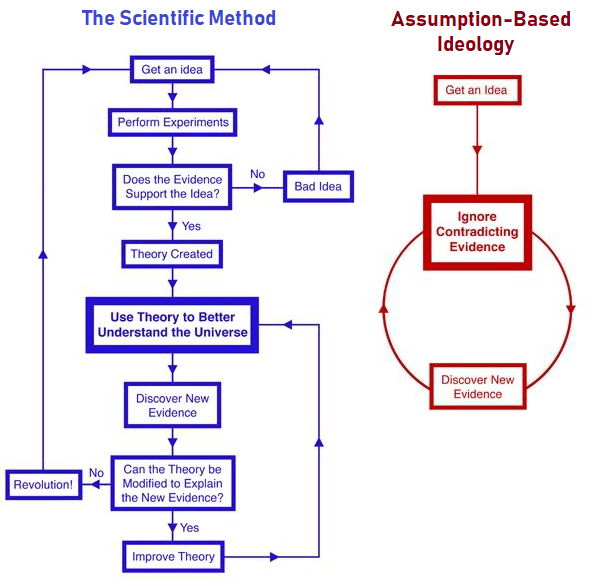
“Our freedom to doubt was born out of a struggle against authority in the early days of science. It was a very deep and strong struggle: permit us to question — to doubt — to not be sure. I think that it is important that we do not forget this struggle and thus perhaps lose what we have gained.”— Richard Feynman“Scientific skepticism is considered good. […] Under this principle, one must question, doubt, or suspend judgment until sufficient information is available. Skeptics demand that evidence and proof be offered before conclusions can be drawn. […] One must thoughtfully gather evidence and be persuaded by the evidence rather than by prejudice, bias, or uncritical thinking.”— Sue Stanley“Science is much more than a body of knowledge. It is a way of thinking. This is central to its success. Science invites us to let the facts in, even when they don’t conform to our preconceptions. It counsels us to carry alternative hypotheses in our heads and see which ones best match the facts. It urges on us a fine balance between no-holds-barred openness to new ideas, however heretical, and the most rigorous skeptical scrutiny of everything — new ideas and established wisdom. We need wide appreciation of this kind of thinking. It works. It’s an essential tool for a democracy in an age of change. Our task is not just to train more scientists but also to deepen public understanding of science.”— Carl Sagan
• Theory vs. Hypothesis
A hypothesis is either a suggested explanation for an observable phenomenon, or a reasoned prediction of a possible causal correlation among multiple phenomena. In science, a theory is a tested, well-substantiated, unifying explanation for a set of verified, proven factors.
• Theory vs. Theory
The word “theory” in casual conversation usually means a guess or a speculation. “It’s just a theory.” The word “theory” as it is used in science is a coherent group of tested general propositions, commonly regarded as correct, that can be used as principles of explanation and prediction for a class of phenomena. A theory in science is so much more than just a guess or a hunch.
 Dead-Logic