This video was originally posted July 26, 2025, days after the death of Hulk Hogan. Since then I did a lot of re-editing, partly due to copyright issues with WWE and partly because I wasn’t happy with the final product and wanted to improve it. I’m still learning and working on finding my style/rhythm with creating vlogs.
We gotta get over the idea that the U.S. government has ever been on the side of the people.
We need to get past the lie that any president wants what’s best for the people, including and especially the elderly diaper-wearing mentally and physically decaying fascist narcissist billionaire child predator who’s currently in the White House.
This is an unlisted playlist of videos from around YouTube that I think are thought-provoking and worth taking the time to watch. Topics range from politics to music to personal wellness and more. I add to this list periodically…
I also have an unlisted playlist of videos from around YouTube about professional wrestling that I think are thought-provoking and worth watching. One of my favorite sayings is, “Everything is pro wrestling.” The more you understand how professional wrestling works, the better you’ll understand how things like politics, social media, marketing, etc. work…
(That is quite a name, now that I think about it.)
Dick Butkus was an American football player for the Chicago Bears from 1965 to 1973. He’s considered one of the toughest and most intimidating linebackers in NFL history.
(If you have a name that sounds like “dick butt-kiss” you have to be tough.)
Butkus had a successful career as a player, a commentator, and he even did some acting. He became a sports celebrity, especially to those of us in Chicago.
This story isn’t about Dick Butkus.
I’m not a gambler. I don’t know anything about parlays or over/under or whatever. I created an account on a gambling app a while back because a coworker was doing it and he kept talking about it and all the talk made me want to try it to see what it was all about.
I placed a $20 bet on the Chicago Bears to win the game they played right after Butkus died, joking that the spirit of Dick Butkus would guide them to victory.
“.M00Ⴇ” – Music & video by me. The fish symbolize how the mega rich and powerful see the rest of us, only here to be lured by their propaganda, and used by them to create even more wealth and power while we stay distracted by entertainment and, for those of us in the United States, the dangling carrot of the “American dream.”
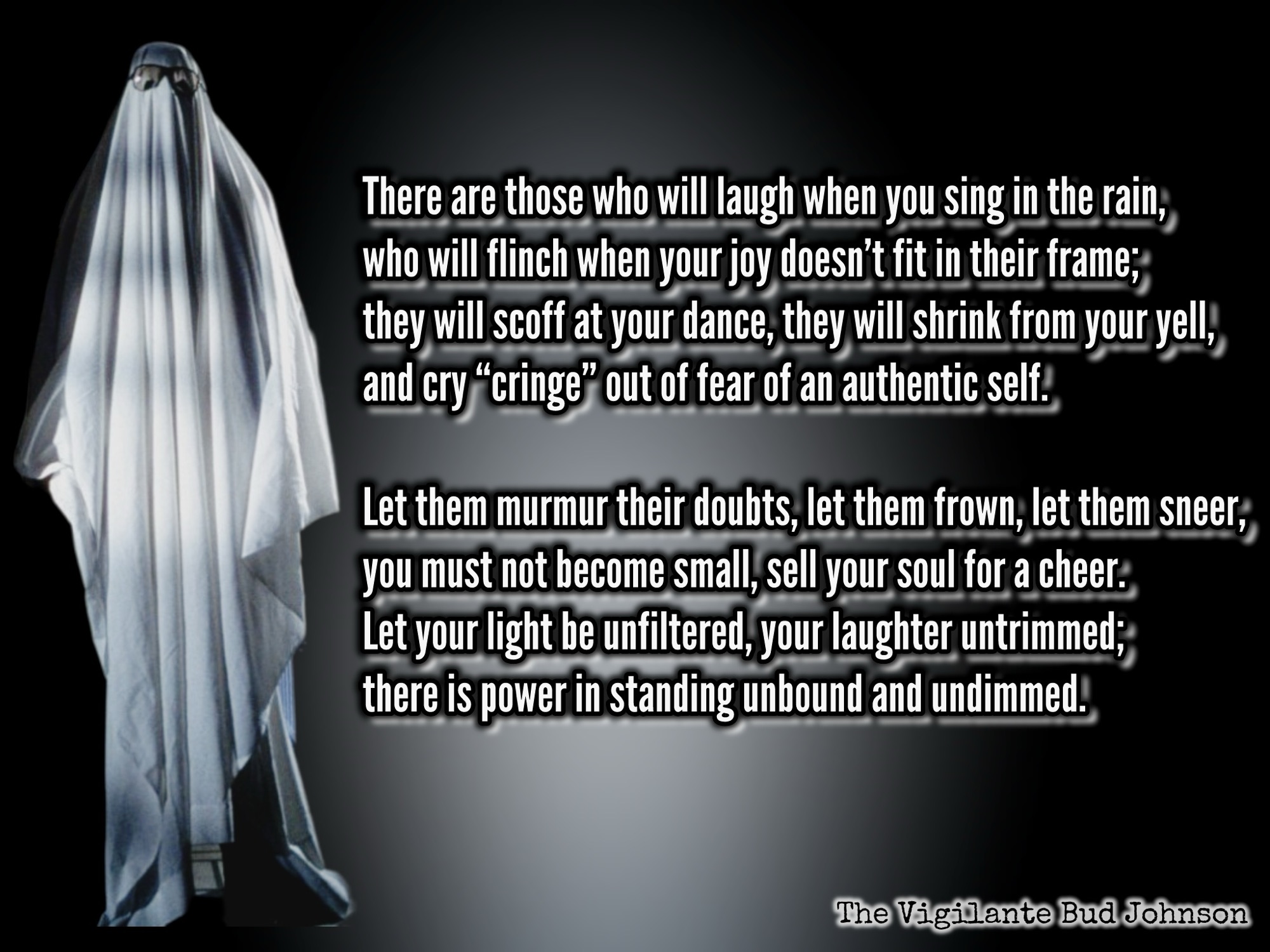
This work is titled, “Be Yourself” or “Screw You I’ll Attend an Alpaca Convention if I Want to”
It’s written in anapestic tetrameter, the same meter as A Visit from St. Nicholas (or “Twas the Night Before Christmas“).
Don’t be afraid to be yourself. Write, make music, sing, dance, post a TikTok, play a sport, bake cakes… express yourself how you want, in a way that conveys your authentic self and makes you happy. If you’re not harming anyone and you’re enjoying your life the best you can, then forget the haters. Their words say more about them than they say about you.
Things might be hard in the wilderness, but you know you can’t go back to Egypt.
The sun burns and blinds you for a while, but you can never return to Plato’s Cave. Sometimes we fool ourselves into thinking that we can.
And no, your favorite restaurant as a kid isn’t what you remember it to be, because you’re not that kid anymore. And that restaurant isn’t what it used to be either.
I was part of the crowd at my local No Kings Day protest on October 18. And I was happy to be involved in it. It was inspiring and motivating for me. And I have a few thoughts about the event.
Seeing so many people speak out against the corruption of the Trump regime was a good reminder that we’re not alone in this fight for freedom and justice. A message was sent, which prompted the president to post an A.I. video of himself wearing a crown and flying a jet while dumping excrement on American citizens.
I can’t believe I just wrote that sentence. Such is the state of the United States right now.
Clearly, our united voices got to him. That’s no surprise. But annoying our would-be dictator isn’t enough. No Kings Day was a success. We sent a message, but if all we do is have a giant block party every once in a while, it’s a message the government can and will easily ignore.
The real work still needs to be done.
We must push back against the false claims of the administration. Contact our elected officials with our concerns. Volunteer to help those in need. Use social media efficiently to convey the message. Support activist organizations and independent media. And, especially for white people like me, listen to the thoughts and concerns of people who are different than us, who have experiences we cannot understand fully, and who have perspectives gained through a struggle we’ve never had to endure.
Listen actively. Learn eagerly and humbly. Then get to work.
I’m not the guy to give advice about this. I’m here to learn and grow and stand for what’s true and right. What I really want to convey in this entry can be summed up in a single sentence…
If participating in No Kings Day is all you’ve done, you haven’t really done anything yet.
I wasn’t going to write anything about Charlie Kirk, partly because this kinda thing isn’t new in the United States. Violence is the norm here, especially gun violence. And as you might know, Charlie’s murder wasn’t even the only school shooting that occurred that day.
I transformed my YouTube channel into “GhostofSocrates” in late 2023, while I was still recovering from when I got hit by a car. While laid up at home with nothing to do but sit around on my phone, I decided to start learning how to make music. It started with me just posting videos of beats I made, but over time I wanted to add some visuals to the music. Then those visuals evolved into me wearing a lobster costume while jump kicking Hulk Hogan (no I will not explain).
This compilation video offers a pretty decent idea of what kind of music I make and what GhostofSocrates has become. It may also be incriminating evidence concerning the state of my mental wellness, but that’s a topic for another time.
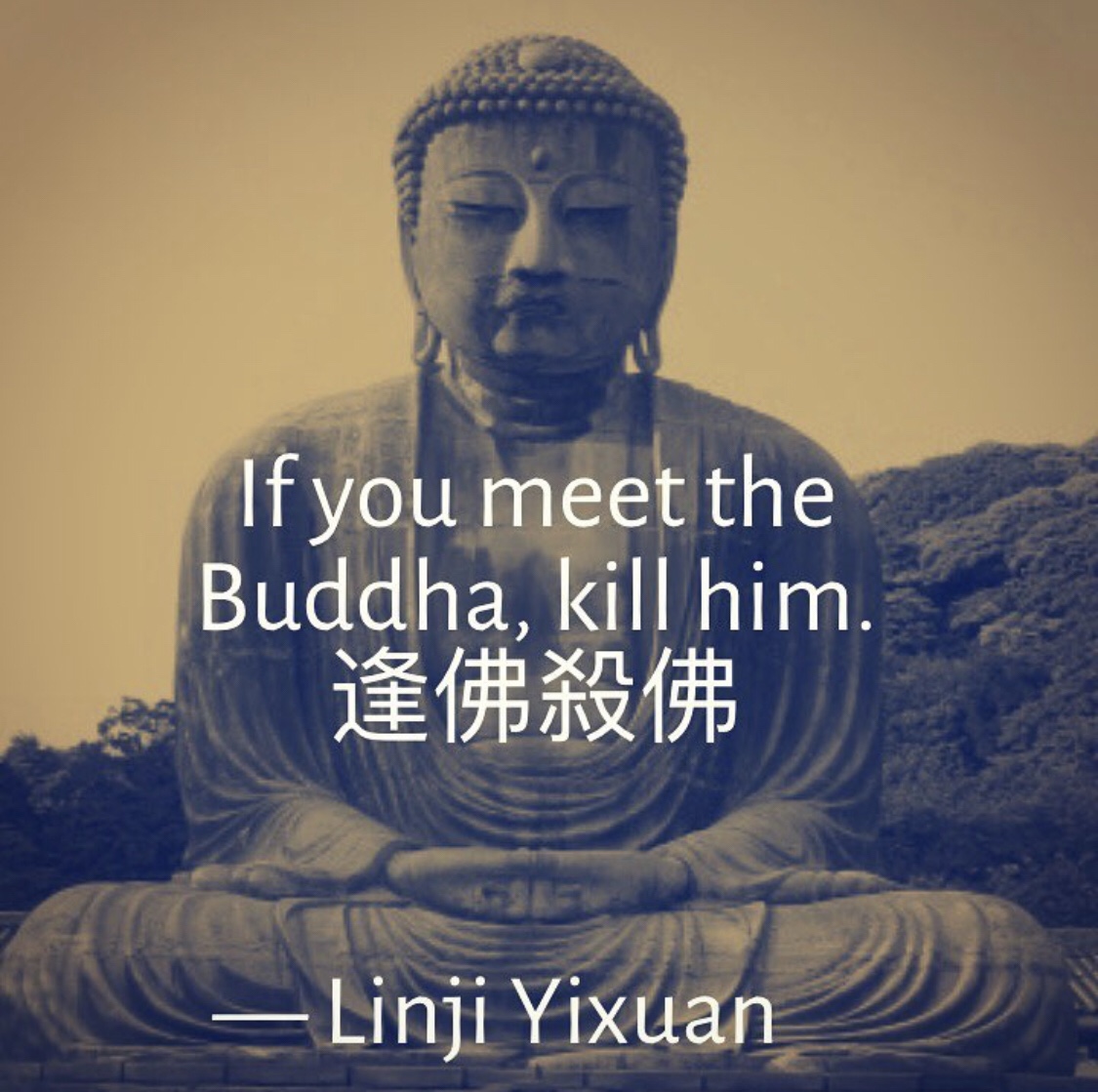
I first heard this saying years ago when, as I wandered around on this fairly new invention called “The Internet,” I stumbled upon a website called “Killing the Buddha.”
As the story goes, a monk deep in meditation experiences what he thinks is enlightenment – the awakening, the Buddha-mind – and reports this to his master.
The master explains to the monk that this is nothing special at all, and can even hinder his real progress. The master then instructs: “If you see the Buddha, kill him.”
While various interpretations of this Zen kōan have been offered over the years, I’ve found value in understanding “the Buddha” we encounter to represent our desire for enlightenment rather than enlightenment itself. Humans long to be right, and we generally hate being wrong. That longing can lead us to convince ourselves we know more than we actually do. It’s a typical human habit to assume or just make something up to fill in the gaps in our knowledge.
“Who am I?” stands as one of the iconic questions of philosophy, alongside “What is the meaning of life?” and “Is there a God?”
Philosophers throughout history have addressed this question. Rene Descartes suggested that our mind and thoughts are our true identity. John Locke’s criterion for personal identity was self-consciousness, which is the ability to reflect upon yourself. For Locke, possessing memories is what makes you certain of who you are. David Hume dismissed notions of having a “self,” arguing that what we think of as “the self” is nothing more than a bundle of perceptions. We take these perceptions and recombine them into meaning and substance based on our previous experience.
(Actually I just made up that name as I’m writing this.)
I’m a martial arts instructor, but I am always first and foremost a student. My goal is to learn, and I like to share what I’ve learned with anyone interested in listening. As I’ve been working towards improving the quality of my life since my accident, I’ve come across a few simple but effective ways to help me achieve goals and improve myself and my life in small but meaningful increments. Here’s what I’ve found so far. If you’re interested in getting a SLAP to get yourself into gear, read on…
I always had two distinct nightmares. One was a dragon who would fly down through the clouds and burn me up with his fire breath.
I always had that dream at home, every night.
On weekends I’d stay at my grandparents’ house, where I’d have a different recurring dream.
My weekend recurring nightmare was of giant ant-like creatures (well, “giant” as in the size of a large dog). They marched in formation like those ants who would steal picnic food in old Tom & Jerry cartoons. I’d be lying in my bed and hear them coming. The thumping of drums matched their steps, then they’d surround my bed (my nightmares were rather cinematic in retrospect). The leader bug had a mantis-like head and would stand at the foot of my bed and try to attack my feet (or something). I wasn’t sure what he was trying to do, but if you’re the kind of person who can’t sleep with their feet outside of the covers, you’ll understand the fear I had.
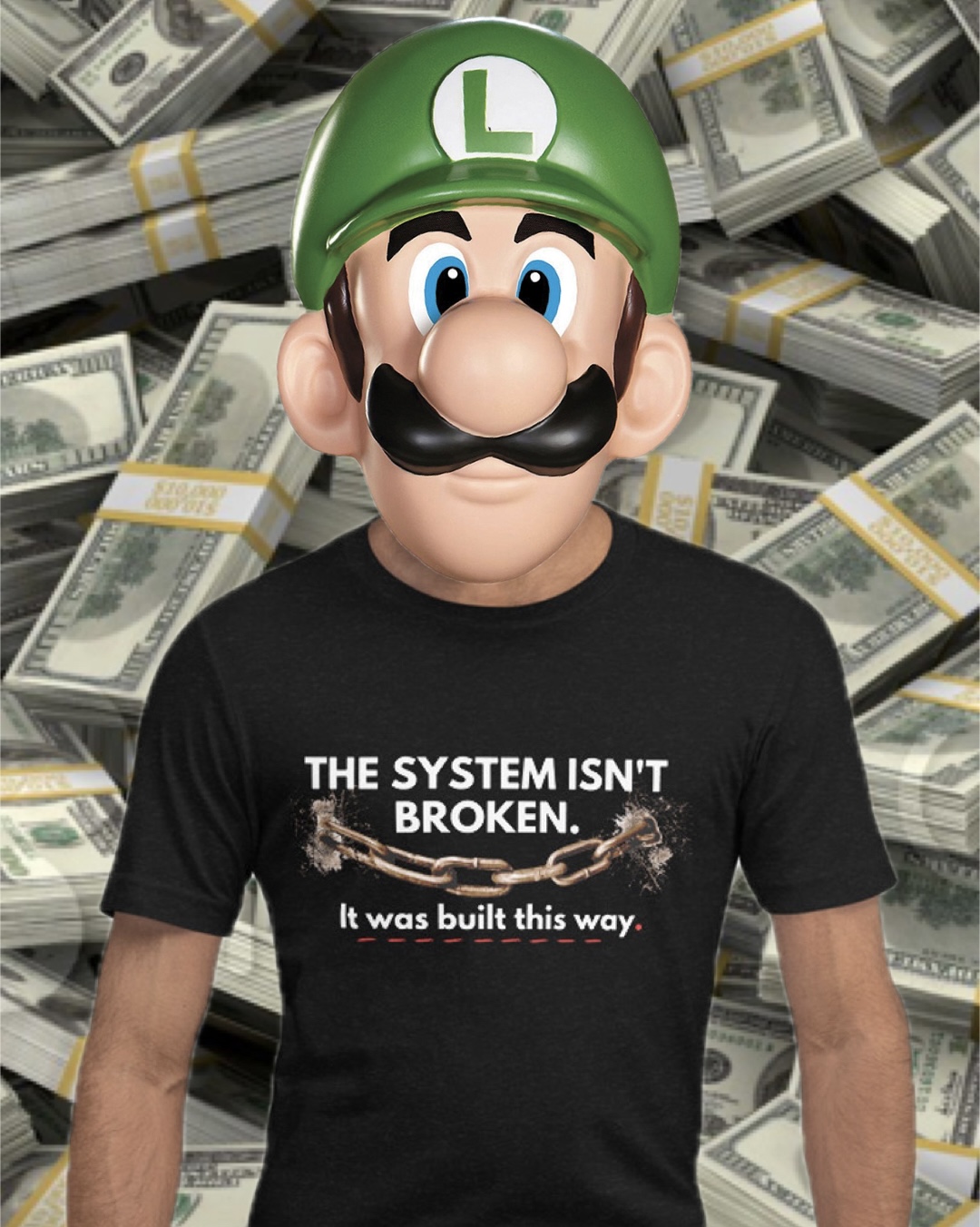
We live in a world of memes. Of course his name is Luigi.
Do I see Luigi Mangione as a hero? Honestly, I don’t have enough information about him to determine what kind of person he is. Do I condone murder? No, not in general. And I generally don’t celebrate a person’s death.
I’m a peace-loving wannabe hippie type of guy. I’m no pacifist, but I believe in practicing understanding, compassion, and grace. I study and teach martial arts for self-protection and personal growth. I’m a Kumbaya / take two and pass / all you need is love kind of guy. So, the fact that I have zero remorse for a dead CEO gives me pause.
How often do we look in the mirror and see things we don’t like? How often do we see things we wish we could change? Why do we feel this way? Who told us we aren’t good enough, or our lives lack value because something we see in the mirror doesn’t fit their criterion?
We’re told everyday how we should look by the media we consume: magazines, movies, television, Internet. Women have it worse, though I know I’ve had moments of self-doubt influenced heavily by the rock-hard six-pack abs I don’t have.
Truth is, healthiness doesn’t come in one size only. Happiness isn’t limited to one body type. People who tell us we’re not good enough are usually just trying to sell us something.
The magazine cover is lying to you: the airbrushed, digitally-altered person on the cover represents the unrealistic bar that has been set. It’s the carrot dangling in front of us that, regardless of how hard we try, we will never be able to reach.
Don’t let society’s conventional wisdom tell you who you should be. If you want to change something about yourself, do it because you want to be a better you, not because you aren’t “good enough,” and not because you need to live up to someone else’s arbitrary standards.
Anyway, here’s an unrelated gif of Neil Breen fighting a white tiger…
I spent a lot of time in my years of studying theology and philosophy pondering the meaning of this seemingly simple directive found in Matthew 18:3-5…
“Change and become like little children.”
Even now, many years since I last considered myself “religious,” I still think about that verse and what it means.
This video is partially blocked on YouTube because of some Hulk Hogan footage I used near the end. My apologies to Pakistan, Nepal, Sri Lanka, India, Maldives, Bangladesh, Russia, Bhutan, and Afghanistan for not being able to watch it on YouTube. You can watch it here instead.
And while I’m here, I’d like to explain more about what the GhostofSocrates brand is about. It’s a reference to the spirit (the attitude and vision) of the Socratic Method. Questions are good. They help us seek knowledge and truth. Questions help us learn something new. For the past year, I’ve been slowly learning more about music theory. I posted my first beat on YouTube eight months ago. Six months ago I started learning the guitar.
I’m not doing any of this for money. I’m doing it for fun and for the love of music and passion for creativity. It means a lot to me, even when I’m dressed like a lobster and jump kicking Hulk Hogan in the face.
This is the basis of my martial arts journey, and, when my head is functioning properly, my life in general.
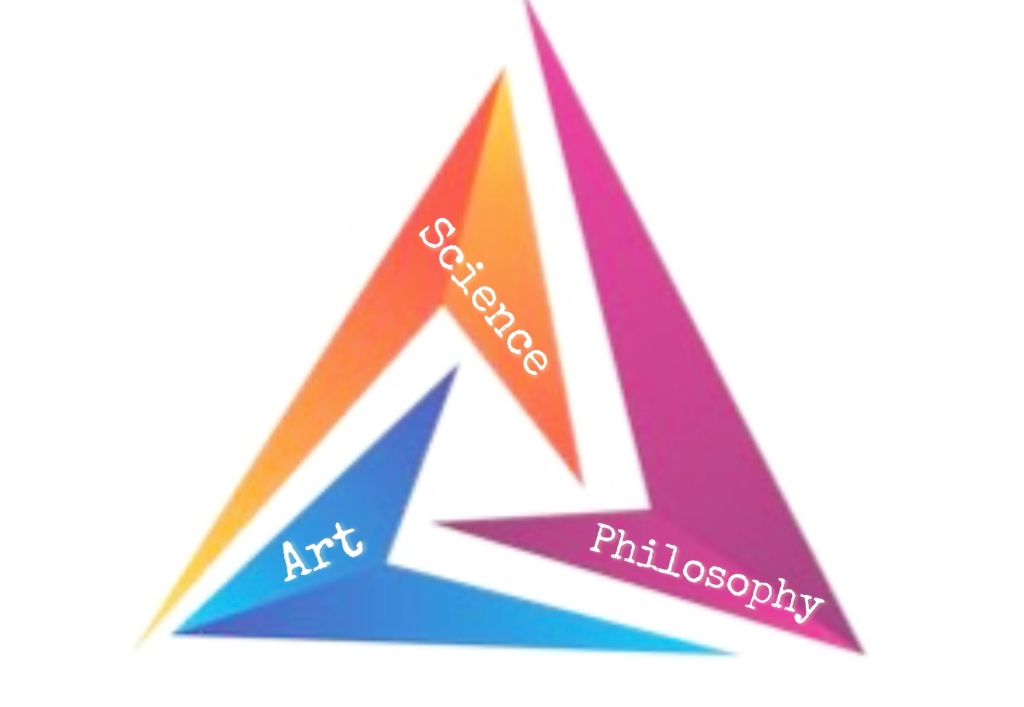
Martial arts is art, which is why it’s in the name. Art is communication, self-expression, and creativity. Over time, a life-long practitioner takes the fundamentals learned and their martial art becomes their own, based on both their personality and physical/emotional strengths and weaknesses. Running a kata or competing in a tournament is akin to the brush strokes of a painter finishing a portrait.
Martial arts is science, at least when one’s martial arts training is focused on practical, logical methods and techniques designed for efficiency. The human body only moves in certain ways. Understanding the biomechanics of the body and physics in general gives a practitioner a greater chance at success in self-defense or sport combat, as well as improve and maintain their health.
Martial arts is philosophy, and while personal views may differ, martial arts training that lacks a cognitive component lacks a reason behind the training. Martial arts functions with the paradox of learning violence to maintain peace, and, in my estimation, each practitioner needs to reconcile their training with their worldview. Martial arts has a deep history from which we can learn, and having a rational basis for why we train will help us become greater martial artists.
And as I said, this triad of art, science, and philosophy serves as the basis of my life in general, though I don’t always apply the principles consistently.
Life should consist of creativity and expression. That’s one reason why I started learning how to create music. Life should be lived according to logic and reason. The better we are able to think and apply critical thinking, the greater our odds of living a quality life. And each of us has a worldview. Everyone is a philosopher. The only question is how good we are at doing philosophy.
As Socrates said, “The unexamined life is not worth living for a human being.”
Wizards of the Coast is making more money than ever with Magic: The Gathering. A big part of that is the work they’ve done to create a digital version of the game. And while we can debate the quality of their products, WotC continues to make big bucks regardless.
“Taking the high road” only elevates you high enough to get knocked down by those who don’t.
I’m tired of bad people knocking me down. Words have power, and now I’m using mine.
Words have more power than we realize. Every time we speak negatively about ourselves, we rob ourselves of our natural power. Our words can destroy, but they can also heal, build, rebuild, and sustain. Every time we encourage ourselves and those around us, we are bolstering the spirit with loving energy, which makes all of us stronger.
My Facebook feed has been full of people condemning the riots but staying silent on the murderers and the systematic oppression that led to the riots.
“Why can’t they protest peacefully?”
Every attempt at peaceful protest has been met with criticism and scorn. And there has been no change to the system that allows for the murders to continue.
Of course riots aren’t good, but it’s important to try to see things through the eyes of the people who have been affected by the murders – murders which themselves are just one part of the larger problem black people face on a daily basis.
Everyone has a breaking point.
Given the context of the situation, when there’s a choice between condemning the rioters or condemning the murderers who have taken so many lives needlessly, the choice should always be to condemn the murderers. They are the real problem here.
Condemning the rioters rather than the murders is an attempt to treat the symptoms while ignoring the disease.
“A worldview is a commitment, a fundamental orientation of the heart, that can be expressed as a story or in a set of presuppositions (assumptions which may be true, partially true or entirely false) which we hold (consciously or subconsciously, consistently or inconsistently) about the basic constitution of reality, and that provides the foundation on which we live and move and have our being.”
— James Sire
I was a freshman in college when I first read Sire’s most well-known work, The Universe Next Door (TUND), the book in which the above quote finds its home. Appropriately, it served as the textbook for my “Introduction to Worldviews” class. The book is referred to as “A Basic Worldview Catalog,” and while Sire’s Christian bias is blatant throughout, TUND provides a decent enough introduction to the competing paradigms and belief systems found in the world.
Sire’s definition of worldview as “a commitment, a fundamental orientation of the heart” indicates that the beliefs we hold about the “basic constitution of reality” are more than mere intellectual assent; they resonate with our most deeply held emotions, passions and values. We define ourselves by our worldviews, and thus value our beliefs as dearly as we value ourselves. For many people, critiquing their paradigm is the same as attacking their being. This is why, in the majority of cases, arguments alone do not sway a person’s thinking.
The mise en scène of philosophy, as depicted by Norman Melchert, is a “great conversation” in which we interact not only with each other, but with the great thinkers of history who have also interacted with each other in the search for truth via an ongoing exchange of ideas and arguments about humanity’s deepest and most importunate concerns. I see the pursuit of philosophy as one’s personal quest for truth couched in the language of a pilgrimage which will continue for the remainder of one’s life. The seeker of truth engages in the great conversation during the course of their journey, administering critical thinking as one encounters the truth claims posited by the remarkable (and not so remarkable) intellectuals of both past and present.
Socrates as presented in Plato’s Dialogues bred much enmity among the self-proclaimed “experts” he questioned due to their embarrassment and humiliation after the Socratic Method – the technique of “question and answer, questioning the answers, questioning those questions, question some more, repeat as necessary” – revealed their ignorance of the subject about which they claimed to have knowledge. This ultimately led to his death. Erroneous accusations of corrupting the youth and advocating religious heresies were made against Socrates and he was brought to trial. The jury of 501 Athenians found Socrates guilty and sentenced him to death by hemlock.
There are certain “rules of engagement” I do my best to follow when I am having a conversation, particularly with people who believe something I don’t. Keep in mind these are my own personal guidelines, and while I think they are good guidelines, I do not believe they represent everything that can be said about how to engage with other people in conversation. These rules serve as a solid starting point from which productive discussion in both business and personal relationships can exist:
“Wonder is the feeling of a philosopher, and philosophy begins in wonder.” — Socrates[Theaetetus, 155d]
A friend of mine who knows I have a degree in philosophy once asked me: “Can you tell me, in one sentence, what philosophy is?” I answered, “Philosophy is the attempt to ask questions about the nature of everything in the pursuit of truth.” I then realized, regardless of how accurate my answer is, it won’t help someone not familiar with philosophy understand what the discipline is. I also considered the fact that several other definitions of “philosophy” can be given that are as accurate, if not more so, than my own. Continue reading “What is Philosophy?”






 Dead-Logic